The construction industry is undergoing a fundamental transformation — driven by tighter budgets, sustainability mandates, and increasingly complex project requirements. Understanding the difference between Building Information Modelling (BIM) and traditional project management isn’t just academic. It’s the deciding factor in whether your next project is delivered on time, on budget, and with minimal rework.
Understanding Traditional Project Management
For decades, construction project delivery has followed a linear, sequential path. A project moves through distinct phases — concept, design, documentation, procurement, construction, and handover — with each discipline working largely in isolation before passing deliverables down the chain.
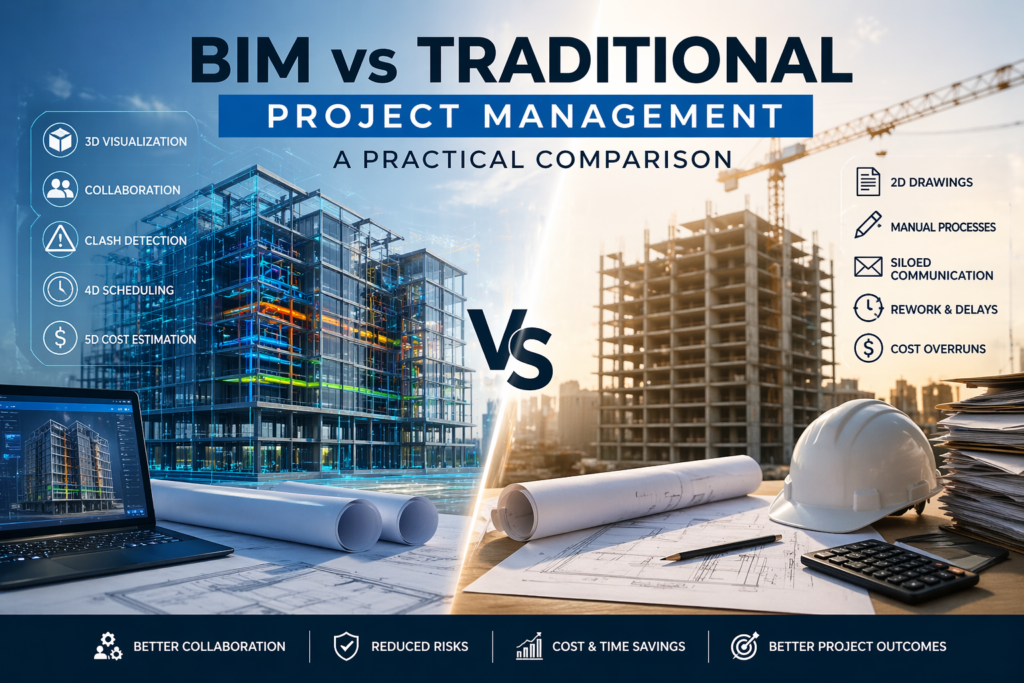
- 2D CAD drawings & documentation
- Manual quantity take-offs
- Separate scheduling systems
- Coordination via email & meetings
- Reactive issue resolution
- Fragmented discipline workflows
- 3D intelligent model (shared truth)
- Automated quantity extraction (5D)
- Integrated 4D scheduling
- Real-time model-based coordination
- Proactive clash detection
- Unified, collaborative platform
While traditional methods have served the industry well on straightforward builds, they consistently struggle when projects demand multi-disciplinary MEP coordination — such as hospitals, data centres, high-rise towers, and large-scale industrial facilities. Coordination conflicts that should have been resolved at design stage are instead discovered on-site, triggering costly rework and schedule delays.
What Is BIM-Based Project Management?
Building Information Modelling is far more than a 3D design tool. BIM creates a single, intelligent, data-rich model that serves as a shared source of truth for every stakeholder — architects, engineers, contractors, and owners — throughout the entire project lifecycle.
| Dimension | What It Delivers | Practical Benefit |
|---|---|---|
| 3D BIM | Spatial design & visualisation | Clash detection before construction |
| 4D BIM | Schedule linked to model | Construction sequence simulation |
| 5D BIM | Cost data linked to model | Automatic quantity & cost updates |
| 6D BIM | Sustainability & energy analysis | Better-performing, greener buildings |
| 7D BIM | Asset & facilities management | Lifecycle value beyond handover |
6 Key Differences That Matter on Site
1. Collaboration & Team Integration
In traditional workflows, conflicts between structural beams and HVAC ducts are often discovered during installation — far too late and far too expensive. BIM’s clash detection software surfaces these conflicts digitally, before a single bolt is tightened, enabling all disciplines to resolve issues together in the model.
2. Cost Accuracy & Financial Control
Traditional cost estimating relies on manual take-offs from 2D drawings. Every design change triggers a complete recalculation — introducing human error and budget uncertainty. In a 5D BIM environment, cost data is directly linked to the model. Change the design; the cost updates automatically.
3. Time Management & Scheduling
Traditional schedules are developed independently from design documents — meaning delays often aren’t visible until they impact physical site work. 4D BIM integrates the construction programme with the 3D model, allowing full simulation of sequencing before work begins, reducing schedule conflicts and improving resource allocation.
4. Risk Mitigation & Predictability
Traditional project management addresses risks after they materialise. BIM’s simulation tools — spatial analysis, energy modelling, constructability reviews — allow teams to identify and neutralise risks during the design phase, before they carry a dollar value.
5. MEP Coordination: A Critical Advantage
Mechanical, electrical, and plumbing systems are the circulatory system of any modern building. Traditional MEP coordination frequently results in tight ceiling clearances, crowded service zones, poor routing, and last-minute site adjustments. BIM-driven MEP coordination resolves these issues in the model — delivering optimised routing, accurate clearances, and improved energy performance.
6. Lifecycle Value & Facility Management
Traditional project management focuses on delivery. Once the keys are handed over, documentation can be incomplete or scattered. BIM delivers a living digital asset model — maintenance schedules, equipment specifications, and operational data that remain accessible and valuable to building owners for the entire life of the facility.
Cost visibility at the time the cost is incurred can make the difference between a profitable bid and a loss — particularly when margins are as tight as today’s market demands.
Why MEP-Intensive Projects Cannot Afford to Skip BIM
Hospitals, data centres, commercial high-rises, and manufacturing facilities share one critical challenge: extremely high MEP service density. When dozens of duct runs, conduit routes, pipe systems, and cable trays compete for the same ceiling void, millimetres matter.
Insufficient ceiling clearance for ductwork · Overcrowded plant rooms with no maintenance access · Inefficient service routing causing material overruns · Last-minute redesigns and expensive site modifications.
For these project types, BIM-based MEP coordination is not simply an advantage — it is a prerequisite. Virtual coordination ensures that all services are installed correctly the first time, on budget and on schedule.
When Traditional Methods Still Have a Place
Small, low-complexity builds — simple residential extensions, single-storey warehouses, straightforward fit-outs — can still be delivered effectively through traditional methods. But as project scale, complexity, or programme pressure increases, the performance gap between BIM-managed and traditionally managed projects widens dramatically.
- Simple residential and single-storey builds → Traditional methods remain viable
- Multi-storey commercial, industrial, or mixed-use → BIM strongly recommended
- Hospitals, data centres, manufacturing plants → BIM is essential
- Fast-track or design-and-construct projects → BIM provides critical time advantages
The construction sector is accelerating toward a fully digital environment. Contractors and consultants who fail to adopt integrated BIM workflows risk being marginalised by more agile, digitally capable competitors.
The Core Difference: Linear vs Integrated Thinking
Traditional project management is sequential by nature — information flows in one direction, and problems discovered downstream are expensive to fix upstream. BIM flips this model. All stakeholders work within a shared, intelligent environment from day one, resolving issues before they become site problems, budget blowouts, or programme delays.
It is not simply a software upgrade. It is a fundamentally different philosophy of how a project is conceived, coordinated, and delivered.
Partnering with the Right BIM Experts
Having access to BIM software is only the starting point. Successfully deploying BIM at scale requires technical expertise, engineering acumen, and hard-won hands-on experience across diverse project types.
Prodigy Engineering Consultants has been delivering advanced MEP and BIM engineering services since 2018, growing into a leading international MEP consulting firm. Their team provides comprehensive project development capabilities using advanced BIM techniques — helping clients reduce risk, minimise total project costs, and raise design quality benchmarks on every engagement.
Ready to Transform Your Next Project?
Whether you’re planning a new development or looking to move away from traditional workflows, BIM-integrated delivery starts with the right conversation.
Book a Consultation Today →