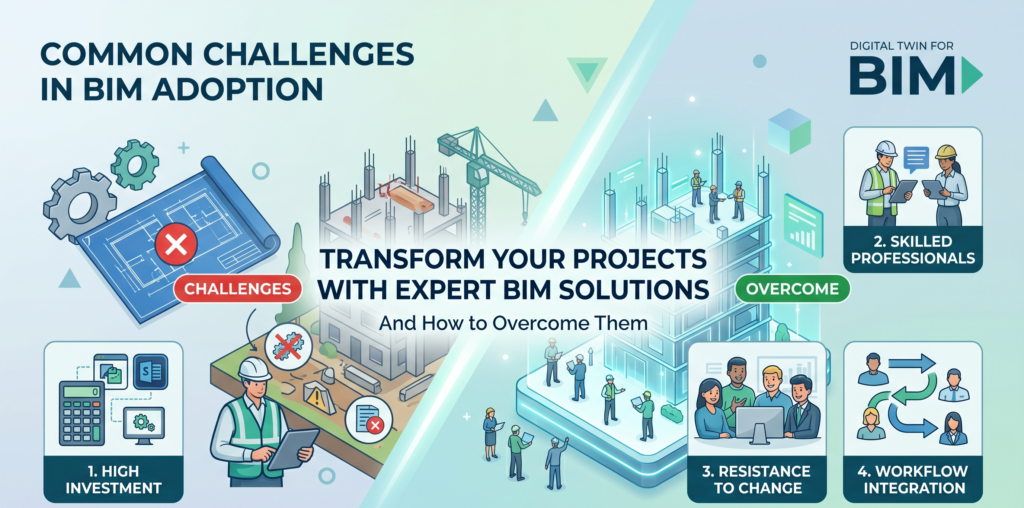
Common Challenges in
BIM Adoption
and How to Overcome Them
From high upfront costs to cultural resistance, BIM adoption is rarely straightforward. This guide examines the six most common barriers — and the practical strategies to move past them.
High Initial Investment
The upfront costs of BIM implementation are often the most significant barrier for small and medium-sized firms. Specialised software licences, high-spec hardware capable of running complex building simulations, and structured employee training all require investment before any return is realised.
While the initial outlay can be daunting, the long-term benefits — reduced rework, fewer errors, faster delivery — consistently dwarf the upfront costs when BIM is implemented effectively.
Start with a phased implementation approach. Rather than investing in the full BIM stack at once, prioritise the tools and workflows that deliver the fastest return for your project type.
- Begin with cloud-based BIM tools to reduce hardware overhead
- Explore subscription licencing to spread software costs
- Identify government grants or industry incentives supporting BIM adoption
- Partner with specialist BIM consultants to avoid costly early mistakes
Lack of Skilled BIM Professionals
BIM demands a specific skill set — 3D modelling, data management, clash detection, and digital collaboration. Many construction firms find it difficult to source professionals with this expertise, and experienced engineers transitioning from traditional CAD workflows often face a steep learning curve.
Build internal capability while leveraging external expertise during the transition period.
- Implement structured BIM training programmes for existing staff
- Partner with consultants who can establish standards, design workflows, and mentor teams
- Collaborate with experienced service providers to reduce the internal learning curve
- Create a BIM champion role internally to sustain knowledge long-term
Resistance to Change
Professionals who have spent decades using traditional methods often feel secure in their existing expertise. The shift to a digital, collaborative platform can trigger fears around technology, redundancy, and loss of professional identity — making cultural resistance one of the most persistent BIM adoption challenges.
Effective leadership and genuine employee involvement are the primary levers for shifting organisational culture.
- Communicate clearly how BIM enhances — not replaces — professional expertise
- Involve team members actively in the transition process from the outset
- Demonstrate how BIM simplifies complex, repetitive manual tasks
- Recognise and reward employees who actively embrace the change
- Provide confidence-building training that is practical and role-specific
Integration with Existing Workflows
Many firms rely on legacy systems — 2D drawing sets, spreadsheet-based management tools, and outdated project management platforms — that were not designed to integrate with modern BIM environments. Bridging this gap can be confusing and inefficient without a clear plan.
Standardisation and a phased migration strategy are critical for smooth integration.
- Develop a clear BIM implementation plan defining roles, data formats, and collaboration procedures
- Establish a single, centralised location for all project data
- Adopt common software applications across all project disciplines
- Phase legacy system conversion to minimise disruption to live projects
- Engage BIM professionals to guide the integration and avoid costly errors
Data Management and Collaboration Issues
BIM models are information-dense — housing data on design, materials, scheduling, and cost. On large, multi-stakeholder projects, managing this volume of information effectively is genuinely complex. Poor data management leads to miscommunication, outdated records, and project-critical errors.
Common Data Environments (CDEs) are the established solution for structured BIM data management.
- Implement a CDE as the single source of truth for all project information
- Define clear communication protocols and standardised naming conventions from project outset
- Hold regular coordination meetings to keep all stakeholders aligned
- Run clash detection processes throughout the design and coordination stages
Lack of Clear BIM Standards
Without defined BIM standards, different teams follow different modelling practices, naming conventions, and documentation approaches. Architects, engineers, and contractors may each interpret BIM guidelines differently — generating inconsistencies that reduce the effectiveness of collaboration across the full project team.
Establish and document BIM standards before implementing the technology on any live project.
- Define modelling levels of detail (LOD) for each project phase
- Standardise file naming conventions and documentation formats across all disciplines
- Develop a BIM Execution Plan (BEP) for every project, understood by all team members
- Review and update standards regularly as tools and processes evolve
The Future of BIM Adoption
BIM is rapidly transitioning from competitive advantage to industry standard. Governments and regulatory bodies worldwide are mandating or strongly encouraging BIM adoption on major infrastructure developments — and firms that navigate the implementation challenges successfully are already reaping the rewards.
Those who invest now in training, standardised processes, and experienced BIM consultancy will be positioned to deliver projects faster, with greater accuracy, at lower cost, and with significantly improved team collaboration.
Transform Your Projects with Expert BIM Solutions
Prodigy Engineering Consultants provides cutting-edge BIM solutions that help construction firms streamline workflows, reduce risk, and improve collaboration — from initial modelling through to project completion.
Contact Us TodayAccurate · Efficient · On Time