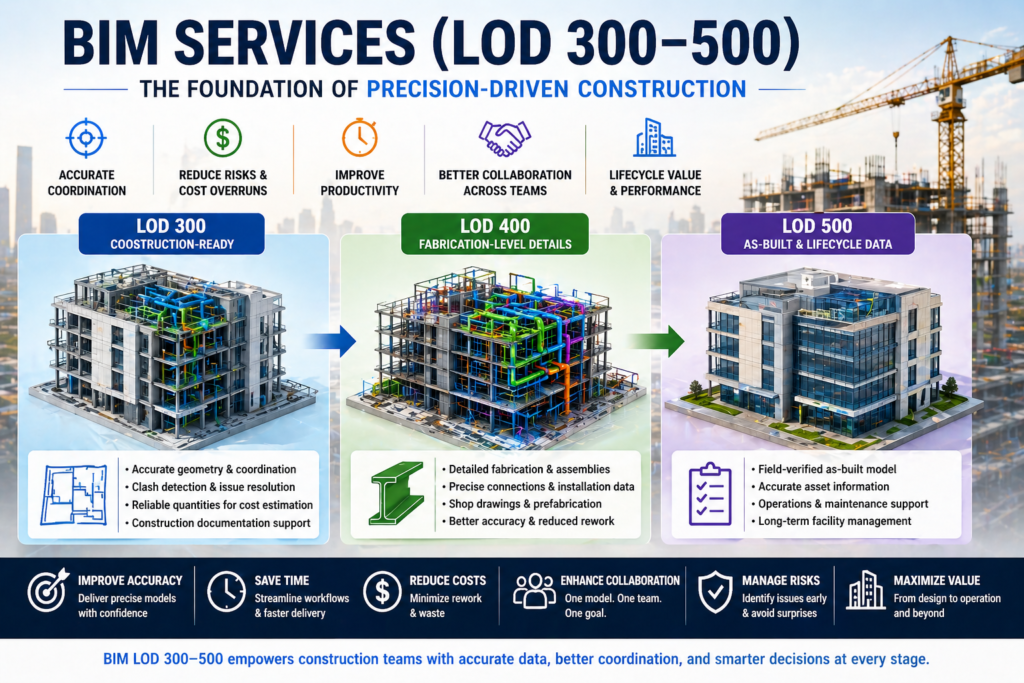
Builders today face increasingly complex construction projects. The need for accurate project planning and documentation, as well as efficient coordination between various stakeholders, is evident given the size and complexity of today’s commercial and infrastructure construction projects.
The MEP systems (mechanical, electrical, and plumbing systems) that provide services to any structure in today’s world are included as a part of that foundation; therefore, even minor errors in any part of the design or coordination can result in substantial delays in financial resources.
In order to meet the demands placed upon them, many construction companies today integrate “back-office MEP support” into their operations. Through back-office MEP support, engineering and contracting firms outsource routine technical design, drafting, BIM modelling, and documentation tasks to specialised teams that complete those tasks remotely and independently. By using this support network, companies can focus on the physical tasks that must be accomplished on-site while relying on qualified engineers to perform the necessary technical services from remote locations.
In addition to enhancing work efficiency for internal teams, back-office MEP support also generates improved project efficiency.
Understanding Back-Office MEP Support
Back Office MEP (Mechanical, Electrical and Plumbing) support is one of the many types of engineering services used by construction companies at an offsite location when creating, documenting and coordinating a construction project. Typically, back office engineers will be part of a specialised engineering group that provides services to the project team from a remote location. The project team, on-site, will continually communicate and coordinate with the back office engineers throughout the duration of the project.
Some common examples of MEP services that are considered back-office services include the following:
- MEP Drafting & Shop Drawings
- BIM Modelling & Coordination
- Advanced Clash Detection
- Fabrication Drawings
- As-Built Documentation
- Construction Document Support
Instead of placing the burden of creating design revisions and documentation onto the project team, construction companies can outsource that work to a back-office team, allowing for quicker, more accurate completion of technical deliverables.
Faster Project Documentation and Design Updates
Construction job sites are constantly changing with design modifications and updates occurring frequently. As the architecture of the building changes, or if site conditions change, MEP drawings will likely need to be changed as well. Having the right support for making those changes can impact how a project moves forward and how quickly it will be completed.
Back-office MEP teams are in place to assist various stakeholders during all stages of the project, delivering reliable support on:
- Revising drawings based on field conditions
- Making rapid design modifications
- Updating multi-disciplinary coordination
- Documenting all applicable standards and compliance
Due to their entire focus being on the technical tasks of the MEP drawings, these teams can support the changes faster than an onsite engineer due to that engineer also having numerous responsibilities. This will result in much quicker turnaround times for updating drawings, allowing the contractors to continue working without major delays.
Improved Coordination Between Disciplines
Coordinating architectural, structural, and MEP systems can be one of the most problematic aspects of construction projects because when these systems do not align correctly, there is a risk of conflict during installation.
An example of this is when an HVAC duct interferes with either a structural beam or plumbing pipe. If any of these types of issues are encountered during construction, it can lead to expensive rework and delays in schedules. Coordination and clash detection are done by MEP groups using sophisticated BIM software prior to the commencement of construction.
BIM will be used to identify conflicts and resolve them before reaching the job site at the design level. This approach fosters collaboration among project teams and minimises the risk of costly mistakes occurring on site.
Reduced Workload for On-Site Teams
Construction managers and on-site engineers manage numerous tasks, including the following:
- Managing subcontractors and field personnel
- Monitoring the status of construction phases
- Monitoring rigorous safety compliance
- Carrying out critical site inspections
- Coordinating the delivery of material and equipment
When on-site teams must also be responsible for the preparation of technical drawings or documentation, productivity may be negatively affected. Back-office MEP support enables the on-site team to concentrate on construction performance and decision-making. This division of responsibility improves the overall workflow and project efficiency.
Access to Specialised Engineering Expertise
While not every construction organisation has access to an extensive in-house MEP engineering group, the high cost associated with hiring full-time specialists per project also makes this option prohibitive. Back Office Support for MEP provides access to a pool of experienced engineers, BIM specialists, and drafting professionals who work exclusively within their field on technical designs and documentation.
In addition, these professionals bring expertise in:
- Advanced BIM Authoring Tools
- Global Industry Design Codes
- Fabrication-Ready Drawings
- Complex MEP Co-ordination
As such, construction companies benefit from access to quality engineering services at a fraction of the cost of expanding their internal teams.
Cost Efficiency Without Compromising Quality
Many construction projects have limited budgets. Keeping costs under control while still providing a quality product is a difficult undertaking.
By using back-office MEP services, companies can cut down their operational costs in various ways:
- By utilizing less on-site staff overhead
- By requiring less physical office infrastructure
- By accelerating the working drawings approval process
- By drastically reducing re-work mistakes on the job site
Remote engineering teams work quickly and specialise in documentation tasks, allowing for faster completion of projects with fewer mistakes. In turn, this increases the profitability of the project and reduces the overall project timeline.
Scalability for Multiple Projects
On many occasions, construction firms are juggling multiple construction projects at the same time. Internal teams often find it difficult to meet the increased demands for design and documentation when their workload increases.
Back-office MEP support offers companies scalability and flexibility. With back-office MEP support, a construction company can easily scale up its engineering support to whatever level is needed for a project. For example, a construction firm can quickly add additional drafting support and BIM resources during peak periods of construction.
As a result, projects can continue to progress without delay as a result of the lack of internal resources.
Enhancing Overall Project Efficiency
The ultimate goal of all construction projects is to finish all work in a timely manner, under budget and free of any technical errors. Back-office support from MEP disciplines contributes to that goal through:
- Increasing the absolute accuracy of technical designs
- Speeding up how quickly actionable documents are created
- Improving coordination among different design disciplines
- Reducing the amount of reactive problem-solving needed on site
- Preventing unnecessary, costly conflicts during the build phase
The implementation of remote engineering support within the workflow of a contractor enhances the execution of their projects and provides superior results.
Conclusion
The increase of complexity within construction projects has led to an increased demand for efficient engineering support. Back-office MEP support offers a viable method for construction firms to efficiently execute design, documentation, and coordination processes.
Remote teams, with their specialisation, provide improved productivity, cost reduction, and faster delivery of projects—all without sacrificing quality. With the intense competition in construction today, the use of back-office engineering support has transitioned from an option to a key strategic advantage.
Partner with Prodigy Engineering
It is essential to have a top-tier engineering support team in place if your project requires accurate MEPs, BIM coordination, clash detection, or ready-for-fabrication drawings. Prodigy Engineering Consultants provides reliable MEP back-office support services that assist contractors in creating streamlined workflows, improving teamwork, and delivering projects on schedule.
Initiate Project ConsultationDiscover the remote engineering advantage