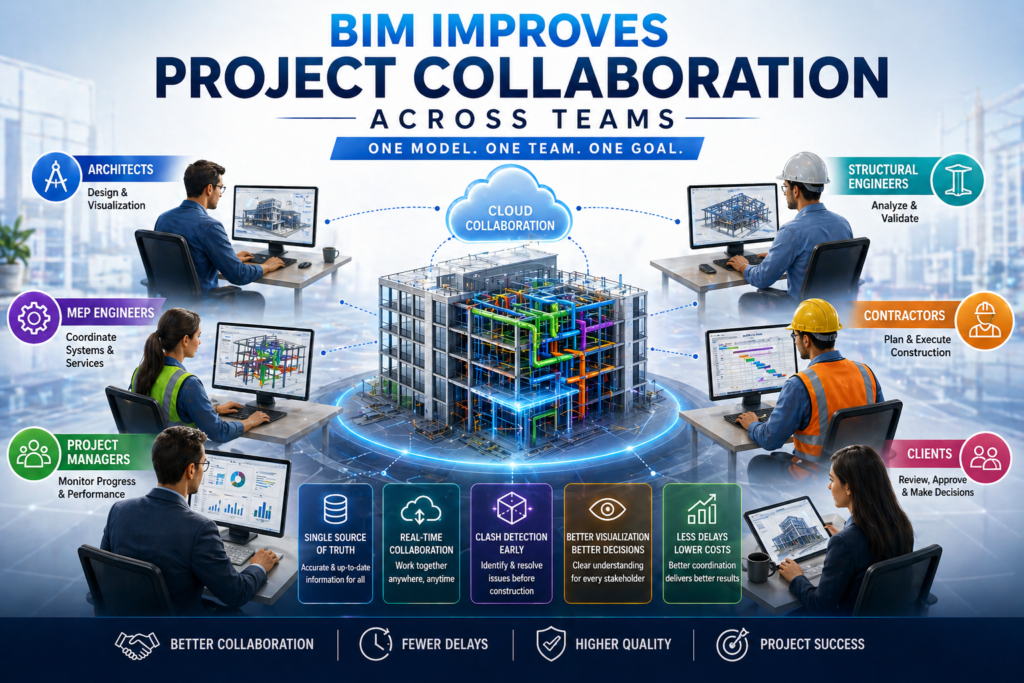
How BIM Improves Project Collaboration Across Teams
In modern design and engineering, working together is no longer a “nice to have”—it is a necessity for project success.
A Single Source of Truth
Traditional workflows involve disconnected drawings and spreadsheets that frequently produce out-of-date data. BIM eliminates this fragmentation by providing a cohesive digital model containing all data related to geometry, specifications, and schedules.
Cloud-Based Access
Remote working is the new standard. Cloud-enabled BIM connects teams across time zones, allowing for real-time design changes and virtual coordination without the need for constant site visits.
Automated Clash Detection
By identifying conflicts between HVAC, structural, and plumbing systems during the design phase, BIM prevents the costly “on-site” fixes that lead to project losses and delays.
Streamlined Workflow & Visualisation
Many non-engineering stakeholders struggle with technical drawings. BIM provides a realistic 3D representation that aligns expectations from day one, leading to quicker decisions and increased confidence.
Instead of a linear, sequential delivery, BIM allows disciplines to work in parallel within the same environment:
- Architectural conceptual models
- Structural load-bearing systems
- MEP service coordination
- Construction sequencing
Transparency & Accountability
BIM provides a detailed audit trail. Track who made changes, when, and what parts were altered. This governance improves quality control and minimizes disputes.
Lifecycle & Facility Management
The model lives on after construction. From 4D sequencing and 5D cost estimating during building, to asset tracking and maintenance planning for facility managers post-handover.