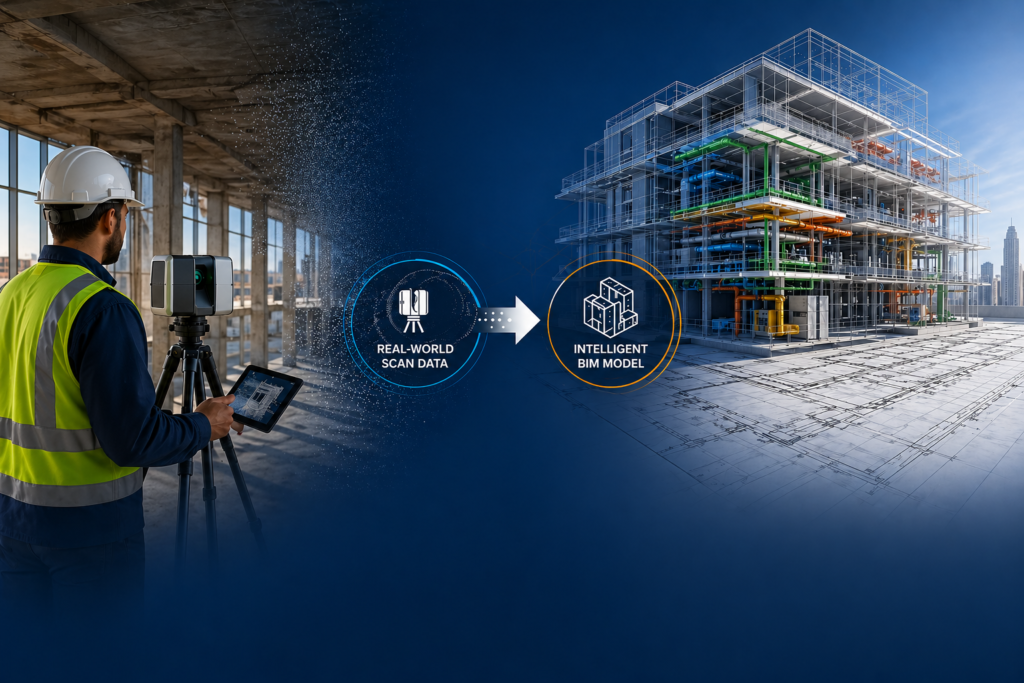
Turning Real-World Data
into Smart Digital Models
Laser scanning meets Building Information Modelling — capturing millions of data points from physical space and transforming them into intelligent, decision-ready 3D models.
Gone are the days when construction was built on drawings and assumptions. Scan-to-BIM captures physical reality with millimetre precision and transforms it into an intelligent digital model — giving every project team a reliable, data-rich foundation from day one.
What Is Scan to BIM
And why it changes everythingUsing cutting-edge 3D laser scanning, Scan-to-BIM captures millions of data points — known as a point cloud — from any physical space. This point cloud is then processed through specialist software into a full Building Information Model that represents not just the geometry of a structure, but all of its architectural, structural, and MEP characteristics.
Unlike outdated drawings or manual measurements, a Scan-to-BIM model is built from the actual existing conditions of the site. The result is a definitive, intelligent base from which every planning, design, construction, and installation process can operate with confidence.
How Real-World Data Becomes a Digital Model
A three-stage capture-to-model workflowLaser Scan
A 3D laser scanner captures millions of precise data points from the physical space — recording every dimension, geometry, and surface condition with sub-millimetre accuracy.
Point Cloud Processing
The raw scan data is registered, cleaned, and processed into a structured point cloud — a dense 3D representation of the real-world environment ready for modelling.
BIM Model Creation
The point cloud is converted into a fully intelligent BIM model containing structural, architectural, and MEP data — a reliable base for all project decisions.
Traditional Methods vs. Scan to BIM
Why legacy surveying approaches fall shortRenovation & Retrofit Projects
Where Scan to BIM delivers its greatest impactRenovation and retrofit projects carry unique risks — the existing conditions of a structure may be undocumented, partially documented, or simply inaccurate. Traditional methods rely on assumptions that produce costly surprises once work is underway.
Scan-to-BIM gives project teams a complete visualisation of the building’s current state before a single change is made. Structural constraints, space limitations, and integration challenges are identified during planning — not during construction.
Commercial Upgrades
Older commercial buildings being modernised benefit from a complete BIM model that ensures all new systems integrate without conflict — reducing rework-related delays significantly.
Healthcare Facilities
MEP-dense healthcare environments require precise documentation of existing conditions before any new system can be safely designed and installed.
Industrial Plants
Complex plant environments where legacy infrastructure and new equipment must coexist demand accuracy that only laser scanning can reliably provide.
Heritage & Historic Structures
Buildings without original drawings or with significant deviation from original plans are accurately documented for the first time through point cloud capture.
Core Benefits
Measurable improvements across every project dimensionUnmatched Accuracy
Sub-millimetre data capture eliminates the measurement errors that cause conflicts, design clashes, and costly on-site rework throughout a project’s lifecycle.
Faster Data Collection
3D scanning captures complete spatial data in a fraction of the time required by traditional manual survey methods — accelerating project timelines from the outset.
Enhanced Collaboration
A single shared intelligent model replaces fragmented drawings and siloed discipline workflows — providing every stakeholder with one aligned, unambiguous view of the project.
Cost & Risk Reduction
Early identification of spatial issues, constraints, and integration challenges prevents the exponentially more expensive corrections that arise during active construction.
Build Smarter.
Start with Real Data.
Our team specialises in high-quality Scan-to-BIM solutions — from precise site capture to intelligent digital model delivery. Give your next project a foundation built on reality, not assumptions.
Accurate · Efficient · Reliable