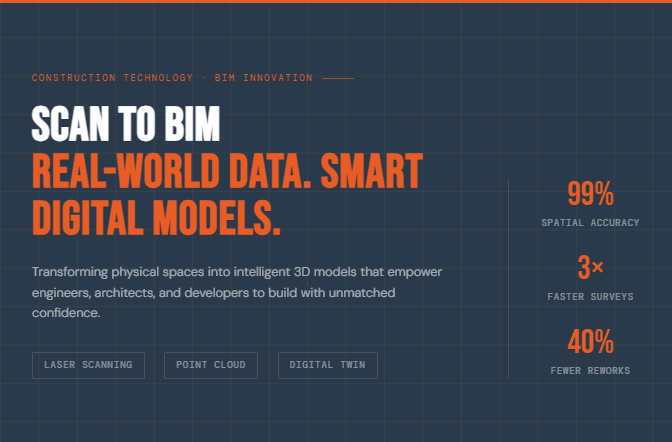
Scan to BIMReal-World Data. Smart Digital Models.
Transforming physical spaces into intelligent 3D models that empower engineers, architects, and developers to build with unmatched confidence.
Gone are the days when construction was primarily based on drawings and assumptions. Today, construction accuracy is essential to how a project is planned, designed, and built. Scan-to-BIM is revolutionising the industry by transforming physical spaces into intelligent digital models — enabling smarter decisions throughout the entire project lifecycle.
What is Scan to BIM and Why It Matters
Using cutting-edge laser scanning technology, data captured through Scan-to-BIM is converted into a comprehensive set of 3D Building Information Models (BIM) illustrating actual existing conditions — rather than outdated drawings or measurements taken manually.
Scan-to-BIM enables facilities teams to obtain access to highly detailed digital representations of existing buildings, dramatically reducing construction and renovation delays caused by inaccurate spatial data.
A single measurement error can trigger conflicts, delays, and cost overruns across an entire project. Scan-to-BIM eliminates that risk by accurately representing every detail of the original structure inside the model.
How Real-World Data Becomes a Digital Model
The process begins with 3D laser scanning — capturing millions of data points (known as a point cloud) from your physical space to create an accurate representation of every dimension, geometry, and feature of the site.
Laser Scanning
High-precision scanners capture millions of spatial data points, forming a dense point cloud of the physical environment.
Point Cloud Processing
Raw scan data is cleaned, registered, and aligned using specialist software to produce a complete, accurate spatial dataset.
BIM Model Creation
The point cloud is converted into an intelligent BIM model containing structural, architectural, and MEP information.
Project Execution
The BIM model becomes a definitive base for planning, design, construction, and handover across all project teams.
The result is an almost perfect digital replica of the physical world — reducing guesswork and improving the efficacy of every decision made from day one.
Solving Real Challenges in Renovation & Retrofit
Scan-to-BIM is exceptionally powerful for renovation and retrofit projects where existing conditions may be unclear or poorly documented. Traditional methods rely heavily on assumptions — producing costly surprises during construction.
With Scan-to-BIM, project teams can visualise the current state of the building before making any changes. Understanding the existing configuration allows teams to identify structural constraints, space limitations, and integration challenges early in the process.
Consider an older commercial building being upgraded: a complete BIM model ensures all new systems integrate without conflict — fewer delays, less rework, lower cost.
Enhancing Collaboration Across Every Team
Construction projects involve many stakeholders — architects, engineers, contractors, and facility managers. Miscommunication between these participants is one of the most common sources of inefficiency and error.
Shared Digital Platform
A single, data-rich model everyone can access and work from — eliminating version conflicts and information silos.
Aligned Stakeholders
All teams share a common understanding from inception to completion, reducing ambiguity and improving coordination.
Faster Decisions
Reliable data enables rapid, confident decisions — shortening approval cycles and keeping projects moving forward.
A Scan-to-BIM workflow ensures all stakeholders align on project goals from inception through to completion — improving coordination, reducing errors, and accelerating delivery.
Improving Accuracy, Speed, and Cost Efficiency
Scan-to-BIM provides a high degree of measurement detail, significantly reducing the likelihood of design inaccuracies or clashes between project components — directly lowering project cost, delay, and risk.
Faster data collection means projects advance without delay from manual measurement. Early identification of potential issues allows corrective action early enough in the construction cycle to generate meaningful savings across the full project budget.
Stakeholders gain real confidence knowing their decisions are based on reliable data rather than assumptions — increasing project value, reducing cost overruns, and delivering consistently improved outcomes.
Partner with Prodigy Engineering Consultants
Our team specialises in delivering high-quality Scan-to-BIM solutions that turn real-world data into powerful digital models — from precise site capture to intelligent BIM delivery.
Get in Touch Today