Top Benefits of
BIM Modeling for
Architects, Contractors
& Developers
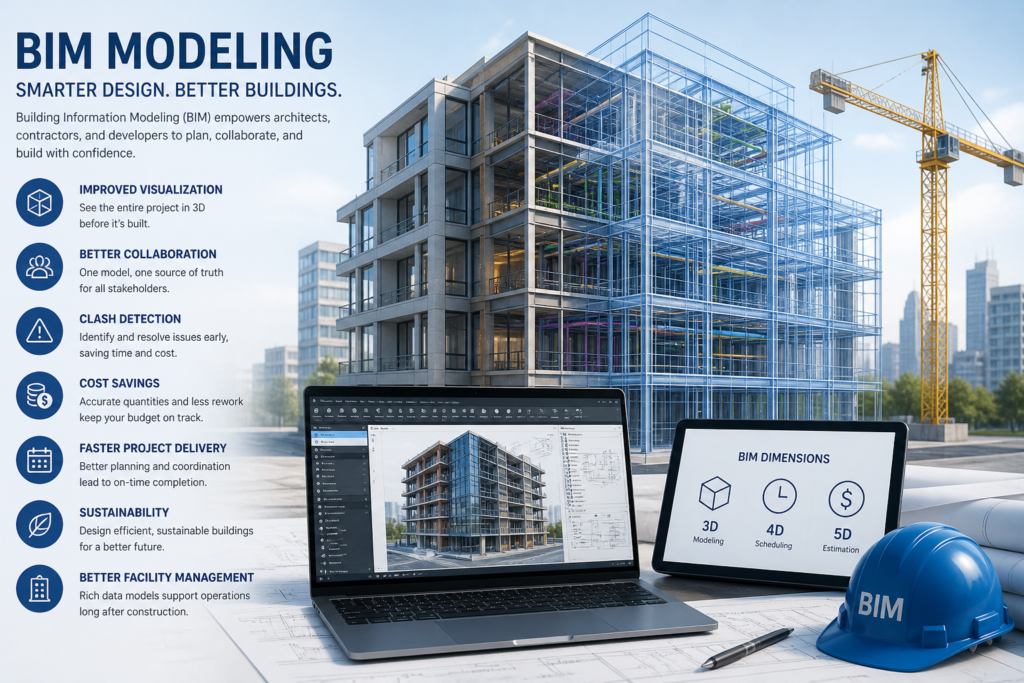
We are past the days of relying on 2D drawings and manual coordination. Today’s construction professionals benefit from Building Information Modeling (BIM) — designing, planning and executing projects with greater precision, speed, and confidence than ever before.
Improved Visualization
& Design Accuracy
BIM provides a major benefit through intelligent 3D modeling. Stakeholders can see their project before it is ever built — rather than relying on imagination to figure out how the building will come together. Architects can try different design options and building materials without spending excessive amounts on mistakes. Developers can visualise the completed product and advise accordingly. Contractors gain a holistic understanding of the project, reducing miscommunication during construction.
Better Collaboration
Across Teams
Construction sites have many parties involved — architects, engineers, builders, and clients. Each must communicate accurately, or delays and costly inaccuracies will follow. BIM serves as a common platform where all parties coordinate their work on a shared model. Any change made by one party is reflected in real time for everyone, so the entire team continues working toward the same goal.
Clash Detection
& Error Reduction
Design clashes are a frequent complication in construction — a pipe running parallel to a beam, or electrical wiring conflicting with structural components. BIM’s clash detection tool identifies these potential issues during the design stage itself, allowing teams to resolve them before they arise in the build phase, saving both time and money. Rather than resolving problems on-site (costly in every sense), BIM empowers teams to fix them digitally.
Adopting BIM is no longer optional — it’s becoming a necessity for staying competitive in the modern construction industry.
Cost Savings
& Budget Control
Every construction project has a budget, and the risk of overrun is real. BIM assists with controlling costs through accurate material estimates and quantity take-offs. Developers can prepare budgets with greater precision, while contractors can reduce material wastage. Cost reductions also stem from fewer errors and rework occurrences — lowering the overall project cost considerably. Think of BIM as your intelligent financial planning tool for construction.
Faster
Project Delivery
In construction, time is money. Any delay results in lost revenue or dissatisfied clients. With BIM, project timelines become more predictable because accurate designs are achievable and clashes are resolved early — so construction flows smoothly. Contractors can plan their schedules with confidence, and developers receive assurance of timely completion. BIM accelerates the entire journey from concept to completion.
Enhanced Project
Planning & Scheduling
BIM’s value extends far beyond 3D modeling. With 4D (time) and 5D (cost) planning, you can sequence construction activities and understand how the project will be built over time. A contractor can determine which activities must come first and understand how a single delay cascades through the schedule. This level of foresight reduces risk, improves resource allocation, and dramatically increases overall efficiency across the project lifecycle.
Improved Quality
& Sustainability
Contemporary construction is not just about building fast — it’s about building right. BIM enables architects to design energy-efficient buildings by assessing natural daylighting, ventilation, and energy consumption within the model. Developers can verify sustainability outcomes throughout the project, while contractors target the highest levels of build quality. The result: functional, eco-friendly structures that meet today’s performance standards.
Better Facility Management
After Construction
The benefits of BIM don’t end when construction is complete. The BIM model acts as a comprehensive digital record of the building — accessible for maintenance, repairs, and future upgrades. If there’s an issue with plumbing, the BIM model can show the exact location and specifications, making maintenance faster and more cost-effective. This long-term advantage makes BIM one of the most valuable investments an owner can make in their asset.
As projects grow more complex,
traditional methods are no longer enough.
BIM provides a smarter, more efficient way to design and build — reducing risks, improving communication, and ensuring better outcomes for architects, contractors, and developers alike. It is not just a technology; it is a new way of thinking about construction.
Unlock the Full Potential of BIM with Expert Guidance
Prodigy Engineering Consultants offers end-to-end BIM solutions tailored to your project needs — from design and coordination to construction support. Advanced technology meets real-world engineering expertise.
BIM (Building Information Modeling) is a digital process that creates detailed 3D models of buildings, incorporating design, structural, and data layers. It helps all project teams plan, coordinate, and manage projects with far greater efficiency than traditional methods.
BIM minimises errors, reduces material wastage, and improves planning precision. By detecting design issues early and enabling accurate quantity take-offs, it avoids costly rework and helps keep projects firmly within budget.
Yes. BIM is beneficial for projects of all sizes. Even small-scale projects gain better design clarity, improved team coordination, and measurable cost savings through BIM implementation.
BIM is used by architects, structural engineers, MEP engineers, contractors, and developers. It ensures all stakeholders operate from a shared, always-current platform — improving collaboration and project outcomes at every stage.